
How Cancrie Nanocarbons Are Transforming Lead-Acid Batteries for Micro-Hybrid Automotive Applications
- cancriecarbon
- Dec 29, 2025
- 2 min read
As automotive platforms increasingly adopt micro-hybrid (start–stop) systems, the performance demands on conventional lead-acid batteries have changed dramatically. These batteries are no longer just energy reservoirs—they must handle frequent high-rate charge acceptance, rapid discharge pulses, and long cycling under partial state of charge (PSoC). At the heart of enabling this shift lies an often-overlooked component: Carbons in the Negative Active Material (NAM).

The Challenge with Micro-Hybrid Applications
In start–stop and micro-hybrid vehicles, the battery works much harder than in conventional cars. Every time the vehicle slows down, it must quickly absorb charge from regenerative braking, and every time it restarts, it must deliver a strong power burst. This happens hundreds of times a day especially in traffic conditions, often without the battery ever reaching full charge. This pushes lead-acid batteries into continuous PSoC( partial state of charge) operation, where traditional batteries suffer from sulfation, poor charge acceptance, and premature capacity fade. The negative plate is especially vulnerable, as lead sulfate crystals grow dense and irreversible, limiting active surface area and ion & charge transport. Over time, this leads to slower charging, reduced fuel-saving benefits, frequent battery replacements, and poor customer experience.
Role of Cancrie Nanocarbons in the NAM
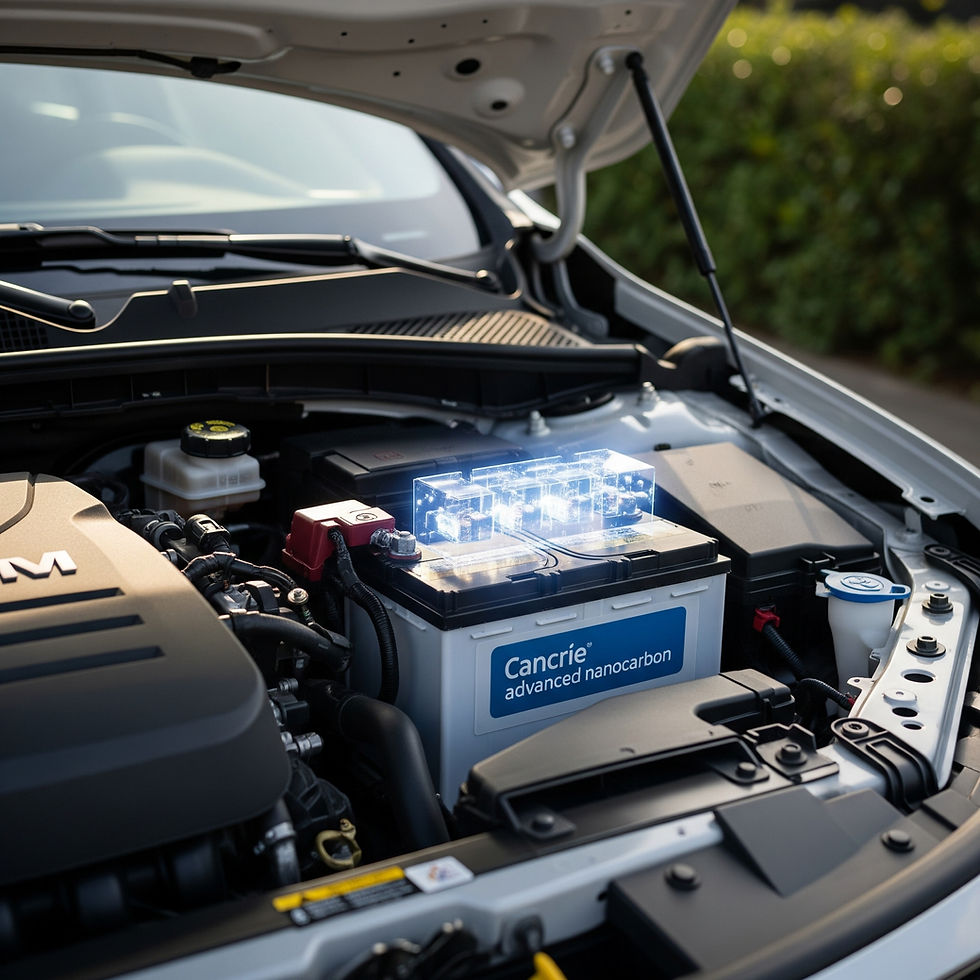
Cancrie nanocarbons are engineered with high surface area, controlled porosity, and optimized conductivity. They act as multifunctional performance enhancers within the NAM. Unlike conventional carbon black, nanocarbons form a conductive, porous network that improves both electrochemical kinetics and mass transport.
Key mechanisms include:
Enhanced DCA: Nanocarbons provide fast ion & electron pathways and electrolyte access, allowing rapid charge uptake during regenerative braking.
Sulfation Mitigation: Their porous structure promotes uniform lead sulfate formation and easier reconversion during charging.
PSoC Stability: Nanocarbons act as a capacitative buffer for local current density spikes, reducing irreversible degradation under start–stop cycling.
Lower Internal Resistance: Improved electronic percolation directly translates to better power delivery and reduced heat generation.
Why Structure Matters More Than Quantity
In micro-hybrid batteries, performance is not driven by how much carbon is added, but how that carbon is structured. Nanocarbons with interconnected pores outperform high-surface-area carbons that lack accessible pathways. This architecture ensures electrolyte penetration deep into the NAM, enabling consistent electrochemical activity across the plate thickness.
Impact on Battery Performance
When integrated into optimized NAM formulations, advanced Cancrie nanocarbons enable:
60% improvement in charge acceptance
20–30% longer cycle life under PSoC
Higher resistance to vibration & shock absorption
Improved fuel efficiency and CO₂ reduction at the vehicle level
These gains make Enhanced Flooded Batteries (EFBs) and advanced AGM designs viable, cost-effective solutions for micro-hybrid vehicles—without the need to fully transition to lithium-ion systems.
Sustainability Advantage
Beyond performance, nanocarbons derived from agricultural waste introduce a sustainability edge. Compared to fossil-based carbons, bio-derived nanocarbons significantly reduce embedded carbon emissions while supporting circular material value chains—an increasingly important factor for automotive OEMs.

Advanced nanocarbons have quietly become a cornerstone of modern micro-hybrid lead-acid batteries. By engineering the right carbon structure within the NAM, manufacturers can unlock higher charge acceptance, longer life, and robust performance under demanding start–stop conditions. As vehicle electrification continues to evolve, nanocarbons will remain a critical bridge between legacy battery chemistries and next-generation performance expectations.


Comments